Hidden APCs and Surprise Fees Authors Wish They'd Known
Your paper got accepted. Then the invoice arrived. Here's what real authors report about article processing charges nobody warns you about.
There's a specific kind of whiplash in academic publishing: months of waiting, a long-awaited acceptance email, and then — almost immediately — an invoice for a fee that was never mentioned, or was mentioned in a font small enough to skip past. That fee is usually an article processing charge, or APC, and surprise is one of the most common reactions authors report having to it.
It's also worth saying plainly: this isn't a fringe problem affecting a handful of unlucky authors. APCs have become one of the standard ways journals fund themselves over the past two decades, which means the odds of running into a fee that doesn't match your expectations only go up as more journals adopt some version of the model.
What an APC actually is
An APC is a fee paid to make a journal article openly available, most often by the author, their institution, or their funder. It's the financial backbone of fully open-access journals, which don't have subscribers to fall back on, and it also shows up in hybrid journals that offer an open-access option on top of a traditional subscription model. None of that makes APCs inherently predatory — most reputable open-access publishers, and a large share of funders including the NIH and NSF, explicitly allow APCs to be budgeted into grants. The issue is less whether the fee exists and more whether you knew about it, and its size, before you needed to pay it.
And the size varies dramatically. Estimates put APCs anywhere from roughly $300 in parts of the social sciences to over $5,000 in some science journals, with broader studies estimating typical total publishing costs in the $1,000–$2,000 range per article. The Proceedings of the National Academy of Sciences, for comparison, charges a few thousand dollars for closed access and adds a substantial surcharge on top for open access. These aren't predatory-journal numbers — they're standard pricing at well-regarded outlets, which is exactly why checking the fee schedule before you submit matters as much as checking the scope.
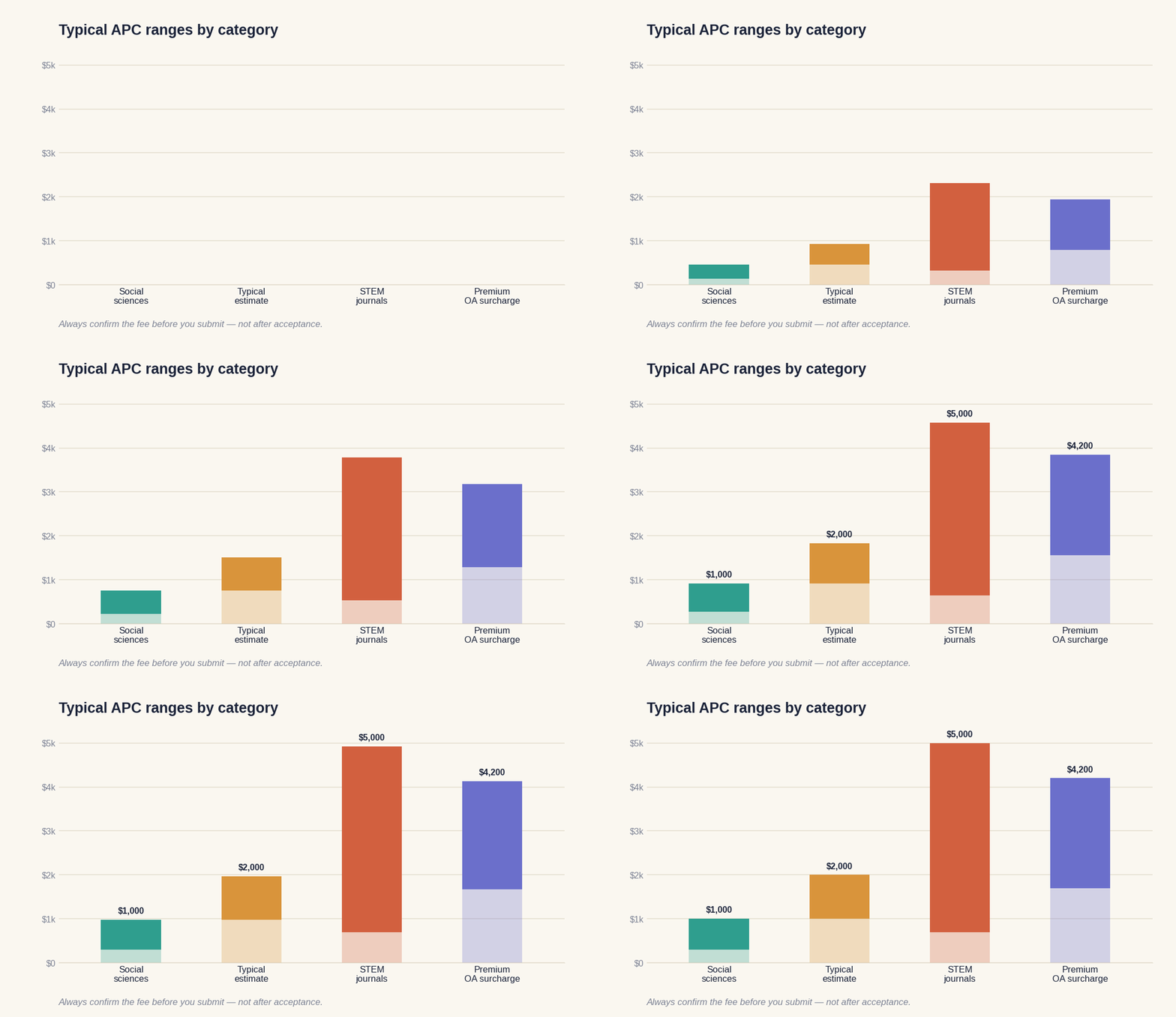 Animated chart comparing typical article processing charge ranges across fields
The real financial squeeze, in numbers
A 2022 AAAS survey of more than 400 U.S. researchers who had previously paid an APC found that 52 percent described obtaining the funds as difficult or very difficult, and 69 percent had used grant money to cover the cost. The trade-offs that created were significant: more than three-quarters of respondents said they'd forgone purchasing equipment or materials to afford an APC, and over half had skipped a workshop or conference for the same reason. The burden wasn't distributed evenly, either — researchers at smaller institutions were three times as likely to report serious difficulty funding APCs as those at larger ones, and women were roughly two and a half times as likely as men to give up a professional development opportunity to cover the cost.
When the bill is bigger than anyone expected
The stories that circulate among researchers tend to follow a pattern: a paper submitted under the assumption that an existing funding arrangement would cover everything, followed by an invoice that didn't match that assumption. In one widely discussed case, a researcher submitting to a publisher-managed journal under a federal open-access mandate was billed several thousand dollars in APCs after a policy change quietly removed an option that had previously been free for that author's situation. Other researchers, recounting their own experiences in the same discussion, described being asked to pay on the order of two thousand dollars for a journal that wasn't even particularly prestigious — money that, in their words, would never have been spent if they'd known about the fee before submitting rather than after acceptance.
The pattern underneath these stories is rarely a journal lying outright. It's a publisher changing terms, an author misreading which version of a hybrid policy applied to them, or a fee schedule that was technically published somewhere on the site but never surfaced clearly during submission. The financial impact on the author is the same either way.
Equity makes this worse, not just inconvenient
Researchers in low- and middle-income countries face a version of this problem that's structurally harder to escape. Many publishers offer full or partial APC waivers for LMIC-based authors, but the practice isn't universal, and some large research-producing countries fall outside existing waiver categories entirely. For researchers without institutional publication funds, an unexpected APC isn't just an inconvenience — it can be the difference between a paper getting published and a paper getting shelved.
How to actually avoid the surprise
A few habits catch most of these problems before they become a bill. Read the journal's fee page directly, not just the submission portal's summary, and look specifically for whether your funder's mandate changes which fee tier applies to you. Ask about waivers explicitly rather than assuming you don't qualify — many publishers don't advertise them prominently. Budget for the APC at the grant-proposal stage if open access is even a possibility, rather than treating it as an afterthought once a paper is accepted. And before you submit, check what other authors actually paid.
That last point is harder than it sounds, because journal websites describe their own fee structures, but they have no incentive to flag when those fees came as a surprise to real authors. Sciverdict exists for exactly that gap — verified authors reporting not just whether their submission experience was good, but what it actually cost them, including fees that weren't obvious from the website. Reading that before you submit is the difference between budgeting for a known cost and discovering one after your paper is already accepted and you have very little leverage left to negotiate.
If a journal's fee structure changes after you've submitted, or differs meaningfully from what the website implied, that's exactly the kind of detail other authors need before they end up in the same position. Create a free account on Sciverdict to check a journal's real fee history before you submit, and to leave your own if you've already been through it.
References
- American Association for the Advancement of Science. "AAAS Survey: Many Researchers Face Difficulties Paying Open Access Fees." October 2022.
- Khoo, Shaun Yo-Seng. "Publishing at any cost: a cross-sectional study of the amount that medical researchers spend on open-access publishing each year." medRxiv, 2020.
- Proceedings of the National Academy of Sciences. "Author Center: Publication Charges."
- The Chronicle of Higher Education. "Making Your Research Free May Cost You."
- "Article-processing charges as a barrier for science in low-to-medium income regions." PubMed Central.