What Happens After You Hit Submit? A Realistic Timeline
Desk review, reviewer assignment, the long silence — here's what real submission data says about how long each stage actually takes.
The worst part of submitting a paper usually isn't the rejection. It's the stretch of silence beforehand, where the status bar says "with editor" and you have no idea whether that means three days or three months. Most of the anxiety around peer review timelines comes from not knowing what's actually normal, so it's worth laying out the real stages and the real ranges researchers report.
The six stages between submission and a decision
Every manuscript moves through roughly the same pipeline, even though journals vary wildly in how long they linger at each step.
Editorial screening comes first — an editorial office checks formatting, scope, and basic ethics compliance, and a handling editor decides whether the paper is even in play. This is also where desk rejections happen, and it's the stage most authors underestimate. Reviewer invitation and assignment follows: the editor invites two or more field experts, and not everyone says yes on the first ask, which is why this step alone can eat a few weeks. Review writing is the stage people picture when they think of peer review — reviewers reading, annotating, and drafting reports on originality, rigor, and contribution. Then comes a decision round, where the editor synthesizes the reports into reject, revise, or (rarely, on a first round) accept. If revisions are requested, author revisions and a possible second review follow, and only after a final decision does the paper move into production.
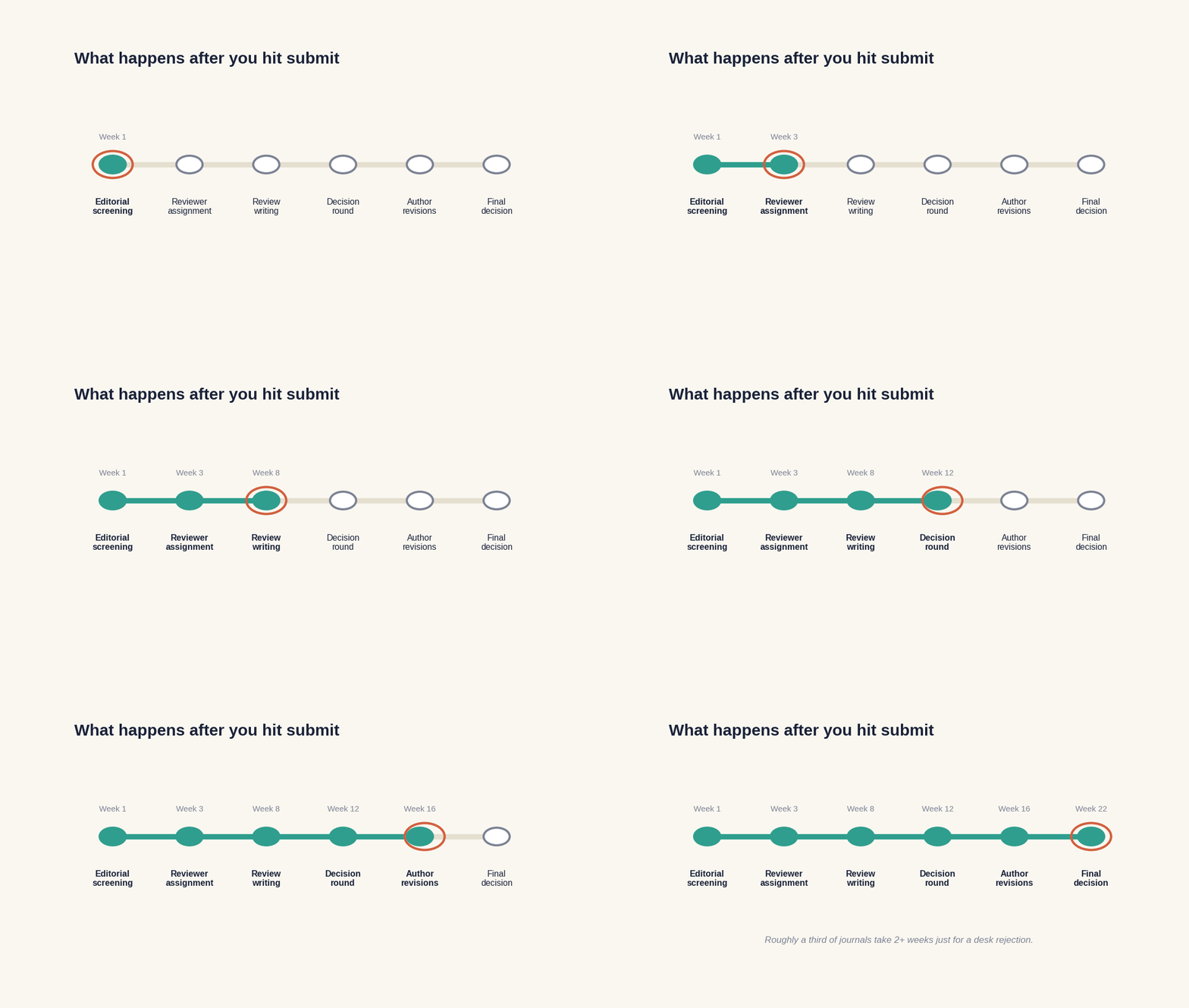 Animated timeline cycling through the six stages from editorial screening to final decision
What the data actually says about timing
An analysis of roughly 3,500 author-submitted review experiences, collected through the peer-review-tracking site SciRev and published in the journal Scientometrics, put real numbers on stages that are usually just guessed at. Desk rejection time alone varied enormously: about a third of journals took more than two weeks to issue an immediate rejection, and one in six took more than four weeks — meaning the "fast no" that's supposed to let you resubmit elsewhere quickly often isn't fast at all. The same analysis found consistent differences by field, with medicine, public health, and the natural sciences moving fastest, and mathematics, computer science, social sciences, economics, and the humanities running noticeably longer.
Other compilations of submission data put the full stage-by-stage range at: editor screening, a few days to a few weeks; reviewer assignment, one to four weeks; active review, four to twelve weeks or more; each revision round, two to eight weeks, with some journals allowing 60 to 90 days for major revisions. Stacked together, three to twelve months from submission to a final decision is a realistic range, and three to nine months more is common before the accepted version is actually published.
So when is silence actually a problem?
A manuscript sitting "with editor" for three weeks is, frustratingly, often completely normal — that window covers the desk check, editor assignment, and the first round of reviewer invitations. A polite status inquiry after four to six weeks with no change is reasonable and won't hurt you. What's genuinely abnormal is a desk rejection that takes months: if an editor needed that long just to say a paper doesn't fit the journal, it's a reasonable signal that the rest of their editorial process is similarly slow, since immediate-rejection time tends to correlate with how the whole pipeline is run.
It's also worth knowing that a fast first decision isn't automatically a good sign. Some journals are fast because they desk-reject aggressively and send very little into full review. Others take longer because more papers make it past the desk and into genuine peer scrutiny. Speed and rigor don't always point the same direction.
Reading a "revise and resubmit" correctly
A request for major revisions can feel like a soft rejection in the moment, but it's worth recognizing for what it usually is: a sign the editor and reviewers think the paper is worth the additional round. True acceptance on a first submission is rare almost everywhere, so a revision request — even a major one — is closer to the expected outcome than an exception. The riskier pattern is a split decision, where one reviewer recommends rejection and another recommends acceptance. In that situation the editor has to adjudicate, and a clear, specific, well-organized response to both sets of comments is what tends to tip a borderline paper toward revision rather than rejection. Asking for more time on a revision, when you ask early and propose a realistic date, is also generally treated as reasonable rather than a red flag — editors consistently say they would rather receive a thorough revision two weeks late than a rushed one on time.
Why field-level averages aren't enough
The numbers above are useful for setting expectations, but they're aggregated across hundreds of journals in a field, and any single journal can sit well outside its field's average — faster, slower, or wildly inconsistent round to round. Knowing that natural sciences journals average a faster timeline doesn't tell you anything about the specific journal you're about to submit to, and a journal's official "average time to first decision" on its own website is usually a marketing number, not a median drawn from real submissions.
What actually helps is seeing what authors who submitted to that exact journal, recently, in your field, experienced — not a category-wide average. That's the gap Sciverdict is built to close: real, dated submission timelines reported by verified authors, broken down by journal, so you can see whether "with editor" for three weeks is normal for this specific outlet or a sign something's stuck.
Using real timelines to plan around the wait
If you're choosing between two comparable journals, a documented track record of six-week decisions versus six-month decisions is a far more practical tiebreaker than the half-point difference in their impact factors. If you're already mid-review and wondering whether to follow up, seeing what other authors waited through at that journal tells you whether your current silence is typical or worth a gentle nudge. And if your own submission just resolved — fast, slow, smooth, or maddening — recording that experience is what makes the next author's wait a little less anxious.
The submission timeline is one of the few parts of academic publishing that's almost entirely undocumented in any standardized way, despite shaping how researchers plan grants, job applications, and entire publication strategies around when a paper might actually appear. Sign up free on Sciverdict to check real timelines before your next submission, and to leave one behind for the researcher who submits after you.
References
- Huisman, Janine, and Jeroen Smits. "Duration and quality of the peer review process: the author's perspective." Scientometrics 113, no. 1 (2017): 633–650.